What's the Long-Term Prognosis for Children with ADHD?
Article at a Glance
- More kids than ever are being identified. The share of U.S. children ages 5 to 17 ever diagnosed with ADHD rose from 9.9% in 2019 to 13.8% in 2025, nearly 1 in 7 (CDC, 2026).
- Most kids with ADHD grow up to do well. In the classic follow-up research, about two-thirds of children with ADHD showed no diagnosable mental disorder by their mid-20s, and nearly all were working (Mannuzza and Klein, 2000).
- ADHD rarely vanishes completely, but it changes shape. The long-running Multimodal Treatment Study of ADHD (MTA) found most kids move in and out of periods of remission. Only about 1 in 10 had ADHD every single year of the study, and about 1 in 10 recovered fully and stayed that way (Sibley et al., 2022).
- What happens after diagnosis matters more than the diagnosis itself. Early identification, consistent treatment, school accommodations, and a supportive home are the factors parents can actually influence.
- Untreated ADHD raises the stakes. In one national study, 32% of teens with combined-type ADHD dropped out of high school, compared with 15% of teens with no psychiatric disorder (Breslau et al., 2011).
- Treatment is linked to safer, healthier lives. A 2025 study of nearly 150,000 people in Sweden found that starting ADHD medication was associated with fewer suicide attempts, less substance misuse, fewer transport accidents, and fewer criminal convictions over two years (Zhang et al., 2025, The BMJ).
- Girls are often diagnosed years later than boys. In a study of 1.3 million Danish children, new ADHD diagnoses peaked at age 8 for boys and age 17 for girls (Dalsgaard et al., 2020).
- ADHD rarely travels alone. About 78% of U.S. children with ADHD have at least one other condition, such as anxiety or a behavior problem (CDC, 2024). Treating those conditions is part of protecting the long-term outlook.
- The teen years are the hardest stretch, and the most important window. Executive function demands explode just as independence grows. Support during adolescence pays off for years.
- One steady, believing adult is a powerful protective factor. A parent, grandparent, coach, or teacher who sticks with a child through hard seasons changes how that child sees himself or herself.
Updated November 2026 with new research.
Table of Contents
Show- Article at a Glance
- The Short Answer: Cautiously Optimistic
- Does ADHD Go Away? Why It Usually Doesn't Just Disappear
- What the Research Shows About Long-Term Outcomes
- Can Untreated ADHD Get Worse With Age?
- ADHD in Girls: Why the Prognosis Often Looks Different
- What Actually Changes Outcomes: The Part Parents Control
- Protective Factors: What Helps Kids with ADHD Thrive
- What to Expect by Age
- Risk Factors: What Makes Outcomes Worse
- When ADHD Comes With Other Conditions
- Three Paths I See Over and Over
- What You Can Do Starting Today
- Ready to Learn More About ADHD at Help For Your Child?
- Frequently Asked Questions
- Sources
- The Bottom Line: Hope and Realism
- Contact Help For Your Child
When I meet with parents to discuss an ADHD diagnosis, two questions come up almost every time: "Will my child outgrow this?" and "Is my kid going to be okay?"
If you're asking these same questions, you're in good company. According to the CDC, the share of U.S. kids ages 5 to 17 diagnosed with ADHD increased from 9.9% in 2019 to 13.8% in 2025 (CDC, 2026). That's nearly 1 in 7 kids, with many worried parents lying awake at night wondering what comes next.
They're fair questions. And my answer is more hopeful and more honest than a lot of what you'll find online.
The Short Answer: Cautiously Optimistic
The long-term prognosis for children with ADHD is good for most kids, especially when ADHD is identified early and treated consistently. Most children with ADHD grow to become adults with careers, build relationships, and lead meaningful lives. ADHD usually doesn't disappear completely, but its symptoms tend to ease and change shape with age, and many adults learn to manage the condition well.
The realistic part? Without diagnosis and treatment, things typically get harder: more school failure, more job trouble, and more anxiety and depression. So the prognosis isn't fixed. It depends a lot on what happens next.
That's what this article is about. We'll walk through what the research actually says, what to expect at each age, what makes outcomes better or worse, and what you, as the parent, can start doing this week.
Does ADHD Go Away? Why It Usually Doesn't Just Disappear
Let's back up for just a moment. ADHD isn't something kids "catch" and then recover from, like the flu. It's a neurodevelopmental difference, meaning it's baked into how the brain is wired from the start.
That's why ADHD doesn't magically vanish at 13 or when high school graduation comes around. What does change is how it shows up in daily life and how much it gets in the way.
Here's what the research shows when experts follow kids with ADHD into adulthood:
- Into the teen years: ADHD persists from childhood into adolescence in about 50% to 80% of cases (Owens et al., 2015, as summarized by CHADD).
- Into adulthood: Estimates of how many still have ADHD as adults range from about 35% to 65%, depending on how the study measured it.
- By the late 20s: In a study of 232 children with ADHD, about 29% still met full criteria for ADHD around age 27 (Barbaresi et al., 2013).
And here's the newest twist. The MTA study followed 558 children with ADHD for 16 years. Researchers found that about 9% achieved full, lasting recovery, and about 11% had ADHD at every check-in. Most kids, nearly 64%, had a fluctuating course, with periods of remission and periods when symptoms came back (Sibley et al., 2022, American Journal of Psychiatry).
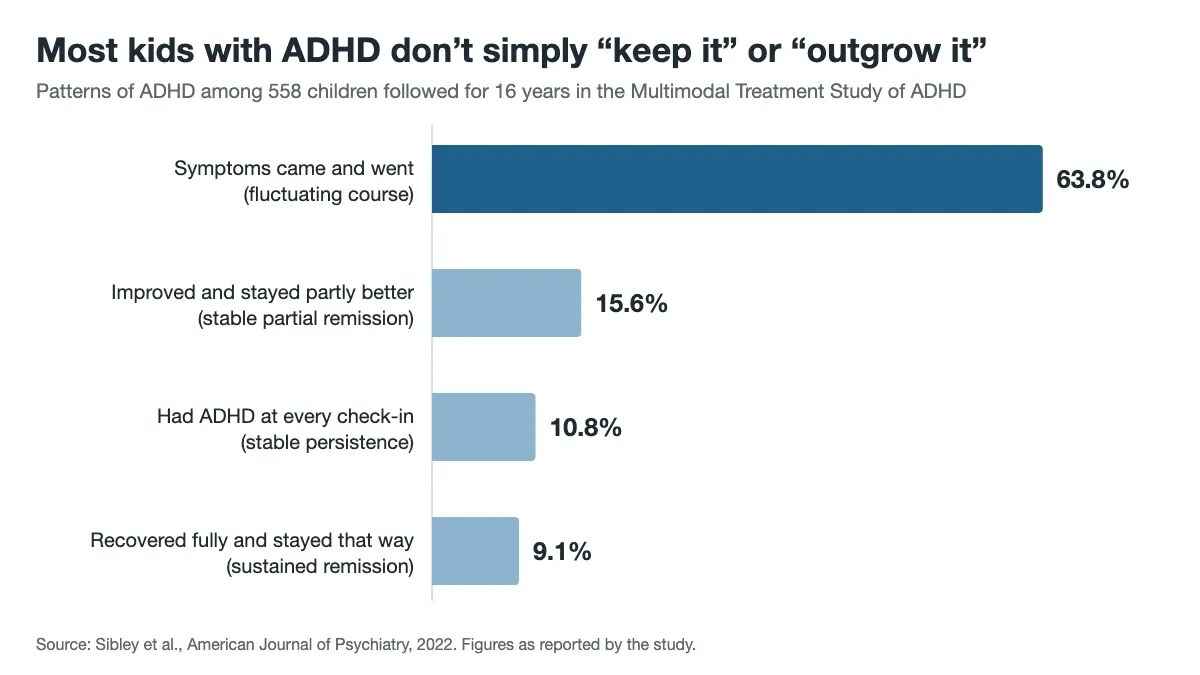
So what does that mean for your kiddo? ADHD is best understood as something that waxes and wanes. There are good seasons and harder seasons. Life changes like starting a new school, going through a breakup, or taking on a demanding job can bring symptoms back, while effective support and treatment can ease them again.
A 2024 follow-up from the same study found that kids in that fluctuating group swung up and down about three to four times over 16 years. And here's the surprise: their better years tended to be their busier, more demanding ones, not their easiest ones (Sibley et al., 2024, Journal of Clinical Psychiatry). As lead researcher Dr. Margaret Sibley of the University of Washington put it, "This study tells us that the environment and ADHD—they talk to each other."
Now for the headline.
Even though ADHD symptoms often linger, about two-thirds of children with ADHD show no diagnosable mental disorder by their mid-20s, and nearly all of them are employed (Mannuzza and Klein, 2000). Most kids do okay. Many do really well.
Download the full-size infographic
What the Research Shows About Long-Term Outcomes
Alright, let's get into the real-world numbers. I'm going to be straight with you here, because you deserve the full picture.
School and Education
Kids with ADHD have a harder road through school. In a national study, 32% of teens with combined-type ADHD dropped out of high school, compared with 15% of teens with no psychiatric disorder (Breslau et al., 2011). Russell Barkley's long-running Milwaukee study found almost the same thing: 32% of children with hyperactivity didn't finish high school (Barkley et al., 2006).
Some of the most detailed outcome research comes from right here in Pittsburgh. The Pittsburgh ADHD Longitudinal Study followed children diagnosed with ADHD into their 20s and early 30s. By young adulthood, 15% of those with childhood ADHD held a four-year degree, compared with 48% of peers without ADHD. Half had attended a vocational school or junior college, compared with 18% of their peers (Kuriyan et al., 2013).
But please hear my words. Those numbers describe averages, not ceilings. I've watched kids with ADHD go on to earn graduate degrees, run businesses, teach, and practice medicine. ADHD doesn't lower a child's potential. It raises the number of obstacles between that child and his or her potential, and untreated ADHD raises it the most.
Work and Career
The same Pittsburgh study looked at young adults with a childhood history of ADHD between ages 23 and 32. Compared with peers, they were 11 times more likely to be neither working nor in school, and about 4 times more likely to be in unskilled jobs rather than clerical work. About 61% had been fired at some point, compared with 43% of peers, and they earned close to $2 an hour less (Kuriyan et al., 2013).
That's real money over a lifetime. And it's precisely why I care so much about the skills we build in childhood: organization, follow-through, and the confidence to keep going after a setback.
Friendships and Mental Health
Kids with ADHD often struggle socially. They're more likely to be left out by peers, and that kind of pain hits different than a bad report card. When social rejection adds to school struggles, it can lead to anxiety and depression.
Teens and adults with untreated ADHD are also at higher risk for substance abuse. Not because ADHD causes addiction, but because impulsivity plus years of feeling "less than" is a risky combination.
Physical Health, Too
New research is widening the lens beyond school and work. A 2026 study in JAMA Network Open followed nearly 11,000 people in Britain from age 10 to about age 46. Those with stronger ADHD traits as children were somewhat more likely to report two or more physical health problems in midlife (42% vs. 37%). Mental health struggles, weight, and smoking explained part of that gap (John et al., 2026).
The gap is modest, and those drivers are things we can do something about. As author Joshua Stott of University College London put it, "People with ADHD can thrive with the right support, but this is often lacking." Healthy sleep, regular exercise, and getting anxiety or depression treated early aren't extras. They're part of protecting your child's long-term outlook.
And Here's the Hopeful Part
Despite the concerning stats, most kids with ADHD go on to do well. In the classic follow-up research, nearly all former patients were working as adults, some in high-level positions, and two-thirds showed no diagnosable mental disorder by their mid-20s (Mannuzza and Klein, 2000).
The difference-makers? Early identification, consistent treatment, and steady parental support during the critical years. Let's talk about each of those.
Can Untreated ADHD Get Worse With Age?
This is one of the most common questions I hear, so let's answer it directly.
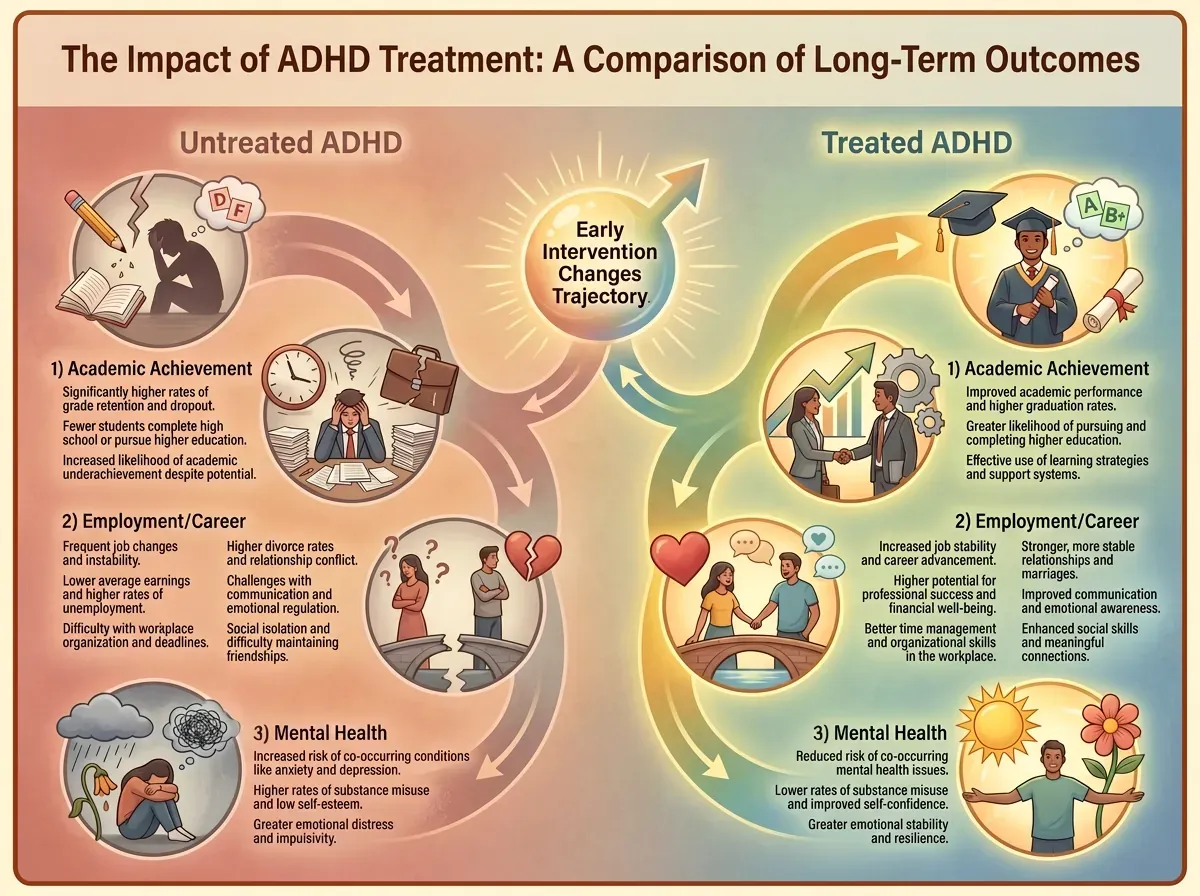
ADHD itself doesn't usually "worsen" the way a degenerative illness does. But untreated ADHD tends to pile up consequences. Every year of struggling without help can mean more falling behind in school, more conflict at home, more rejection by peers, and more damage to self-esteem. By the teen years, those secondary problems (anxiety, depression, risky behavior) are often harder to treat than the ADHD itself.
Treatment changes that story. In a 2025 study that followed 576 children with ADHD in Türkiye over five years, children who stayed on medication longer showed greater overall improvement (Ercan et al., 2025, Psychiatry Research). And the large 2025 Swedish study in The BMJ found that people who started ADHD medication within three months of diagnosis had about 17% fewer first suicide attempts, 15% less substance misuse, 12% fewer transport accidents, and 13% fewer criminal convictions over two years than those who didn't start (Zhang et al., 2025).
Medication isn't the only tool, and it isn't right for every child. That's a decision for you and your child's prescriber. But the research is clear that leaving ADHD untreated isn't a neutral choice.
Download the full-size infographic
ADHD in Girls: Why the Prognosis Often Looks Different
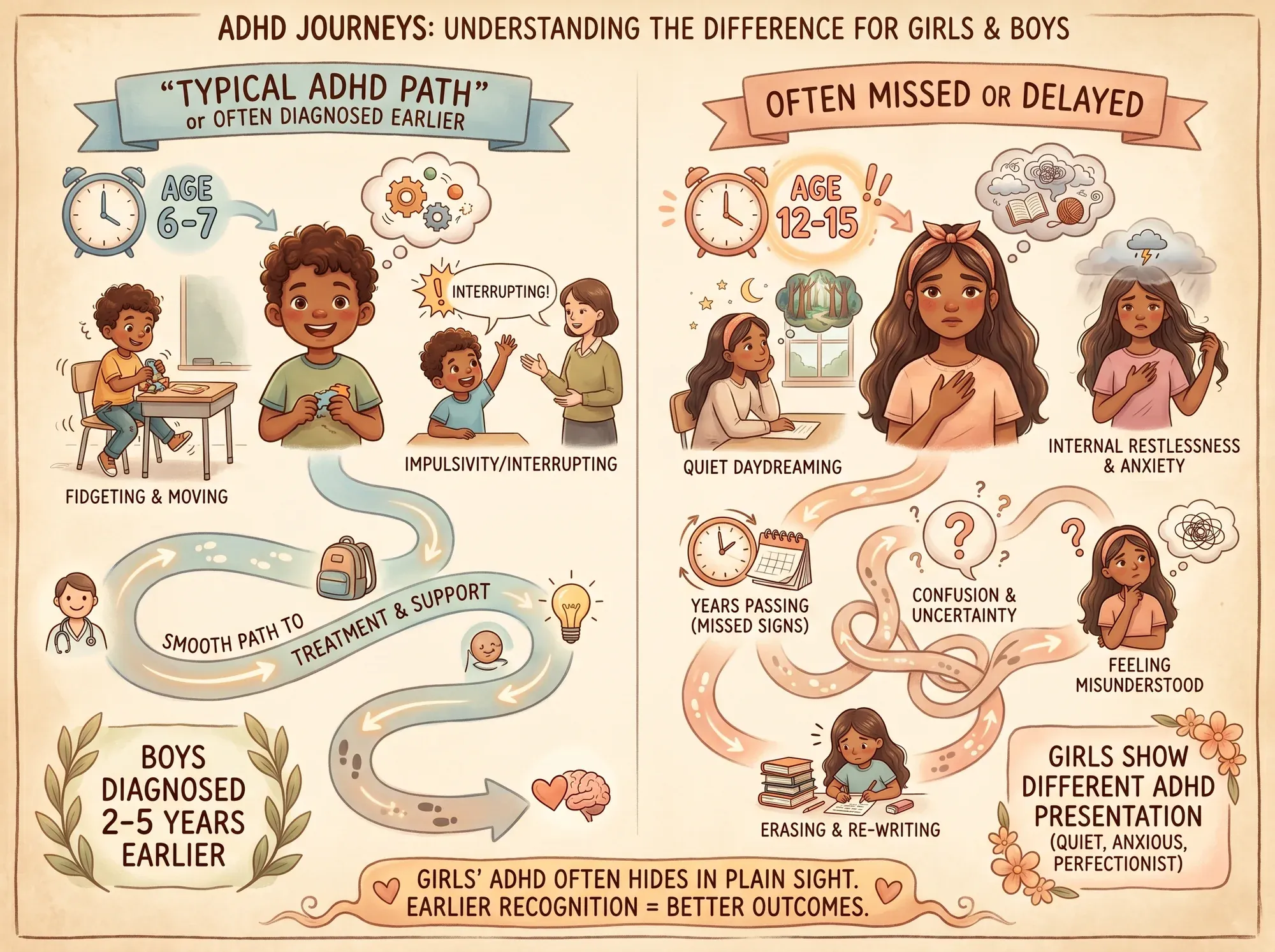
Here's something I see constantly in my office: girls with ADHD are often identified much later than boys, and that delay shapes their outcomes.
Why Girls Get Missed
Boys with ADHD tend to show the hyperactive presentation. They're bouncing off the walls, interrupting class, and getting noticed. Diagnosis often comes at age 7 or 8.
Girls, especially those with the inattentive type, are often the quietest daydreamers. They're not disrupting anyone. They're sitting in the back, struggling to focus, turning in half-finished work, and sometimes working twice as diligently to hide it. Some are perfectionists. Some are anxious about being "found out."
The result? Diagnosis often comes years later. In a study of every child born in Denmark from 1995 to 2016 (1.3 million kids), new ADHD diagnoses peaked at age 8 for boys and age 17 for girls (Dalsgaard et al., 2020, JAMA Psychiatry). Studies differ on the exact size of the gap, but they agree it's real.
What That Delay Costs
By the time a girl's ADHD is caught, she may have spent years wondering, "Why can't I keep up with my friends?" In an 11-year follow-up of girls with ADHD, 62% still had impairing symptoms as young adults, and they had higher risks of depression and anxiety disorders than girls without ADHD (Biederman et al., 2010, as summarized by CHADD).
Treatment addresses the ADHD. The accumulated self-doubt takes longer to heal.
What Helps Girls
Girls with ADHD do best with early recognition, strengths-based parenting (catching what they do well, not just correcting what they don't), mentors who understand them, and paying close attention to anxiety and mood.
If you have a daughter you're worried about, don't wait for a teacher to mention it. Ask for an evaluation.
Download the full-size infographic
If you're skeptical about ADHD as a diagnosis or wonder whether it's overdiagnosed, you might want to read The Facts and Fallacies of ADHD and How Is ADHD Diagnosed, and Is It Overdiagnosed?
What Actually Changes Outcomes: The Part Parents Control
Okay, let's talk about what separates kids who thrive from kids who struggle. In my experience, it's rarely how severe the ADHD is. It's what happens after the ADHD is identified.
Dr. Sibley, whose research we discussed earlier, summed up the good news well in CHADD's Attention magazine: ADHD "can be managed effectively with the right strategies." Here are the strategies that matter most.
Early Identification
Does it matter whether a child is identified at 6 or at 12? Yes. A child identified at 6 receives years of support before the heavy demands of middle and high school. A child identified at 12 is often already behind, academically and socially, and carrying a story about being "lazy" or "bad."
Early intervention doesn't cure ADHD. It prevents a lot of secondary damage.
Consistent Treatment
Consistency matters more than perfection. Kids whose families keep treatment going, whether that's medication taken as prescribed, therapy appointments kept, or coaching sessions attended, tend to do better than kids whose treatment starts and stops. The 2025 Psychiatry Research study above pointed in the same direction: longer treatment, better improvement.
Parent Training in Behavior Management
Here's one that surprises parents. The American Academy of Pediatrics recommends parent training in behavior management as the first-line treatment for preschoolers with ADHD (ages 4 and 5), ahead of medication, and also recommends it for children up through middle school age (AAP, 2019).
That's research-speak for "parents learning specific strategies that help an ADHD brain succeed": reward systems that actually work, consequences that make sense, and instructions that get through. When parents understand ADHD, they stop blaming themselves (and their child) and start building the structure that helps.
School Advocacy
Formal school supports matter. An IEP (Individualized Education Program) or a 504 Plan can provide extra time on tests, a quieter testing space, homework check-ins, and behavior supports through the day.
Parents who request these supports in writing and regularly follow up with teachers provide their kids with a real advantage. For many teens, that's the difference between "I'm stupid" and "I just needed a different setup."
The Emotional Climate at Home
This one doesn't always make it into research papers, but I see it every week. A child with ADHD who lives with constant criticism and frustration starts to believe he or she is broken. A child whose parents understand ADHD, talk about it openly, and offer warmth while still setting clear limits? That kid builds resilience.
Treating the Whole Child
Most kids with ADHD don't have "just ADHD." According to the CDC, about 78% of children with ADHD have at least one other condition, and about 4 in 10 have anxiety (CDC, 2024). Sleep problems are common too. Treating only the ADHD while anxiety or poor sleep quietly grows is like bailing water without patching the leak.
Want more on the day-to-day skills that bridge diagnosis and long-term success? My article ADHD: What's Executive Functioning Got to Do With It? digs into time management, planning, and follow-through.
Protective Factors: What Helps Kids with ADHD Thrive
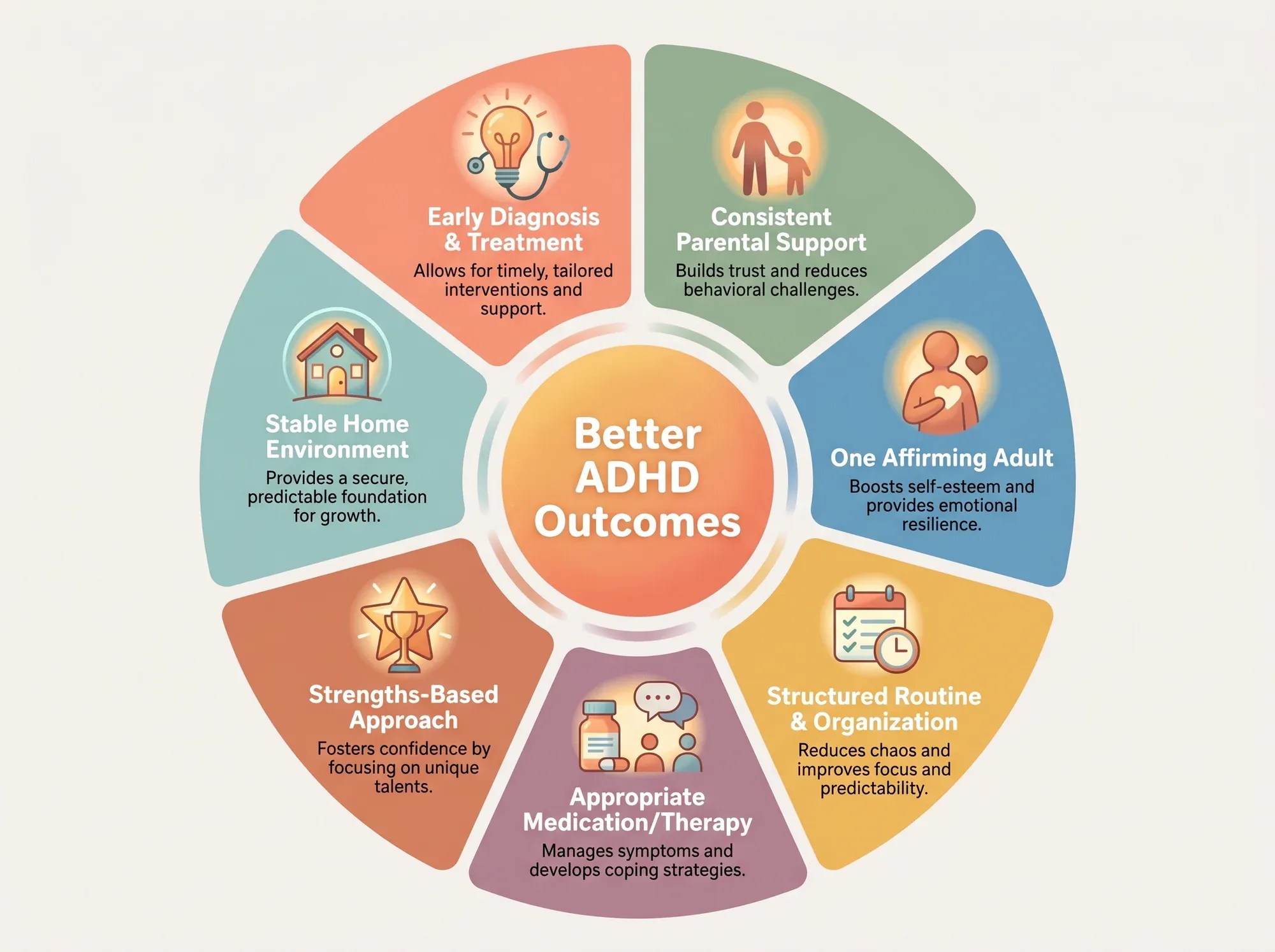
We've talked about what parents can do. Now let's take a broader look at what predicts resilience.
Download the full-size infographic
One Steady, Believing Adult
This is one of the most powerful protective factors I know of. Not medication. Not the perfect school. Someone who believes in the kid, sees his or her potential, and sticks around on the hard days.
It could be you. It could be a grandparent, a coach, a teacher, or an aunt or uncle. Kids with ADHD get a lot of rejection, from peers, from teachers, and sometimes from tired parents. One person who says, "You're not broken, I believe in you, and I'm not going anywhere" can change a child's whole trajectory.
The Right Fit at School
Not every child thrives in a conventional classroom. Many kids with ADHD do better in smaller classes, hands-on or project-based settings, or programs that move at a different pace. Choosing the environment that fits your child, rather than the one everyone else picks, is a gift.
A Place to Shine
Sports, art, music, Scouts, robotics, and theater. Kids need at least one place where ADHD isn't the main story. Confidence earned on the soccer field or the stage often carries over into the classroom.
And remember the MTA finding: kids with ADHD tended to do better in years when their lives were fuller and more demanding. For an ADHD brain, structure and a good reason to show up aren't extra stress. They're scaffolding.
Strengths That Point Toward a Future
Many adults with ADHD do really well in work that matches how their brains are wired: high-energy, hands-on, creative, or fast-paced fields. Helping your child notice what he or she is good at, not just what needs fixing, sets the stage for a career where ADHD is less of a liability and sometimes even an asset.
A Multimodal Plan
Medication helps many kids. Behavior therapy helps. Coaching and school supports help. When combined and kept consistent, these approaches work best. That's what "multimodal" means, and it's how we approach ADHD treatment at Help For Your Child.
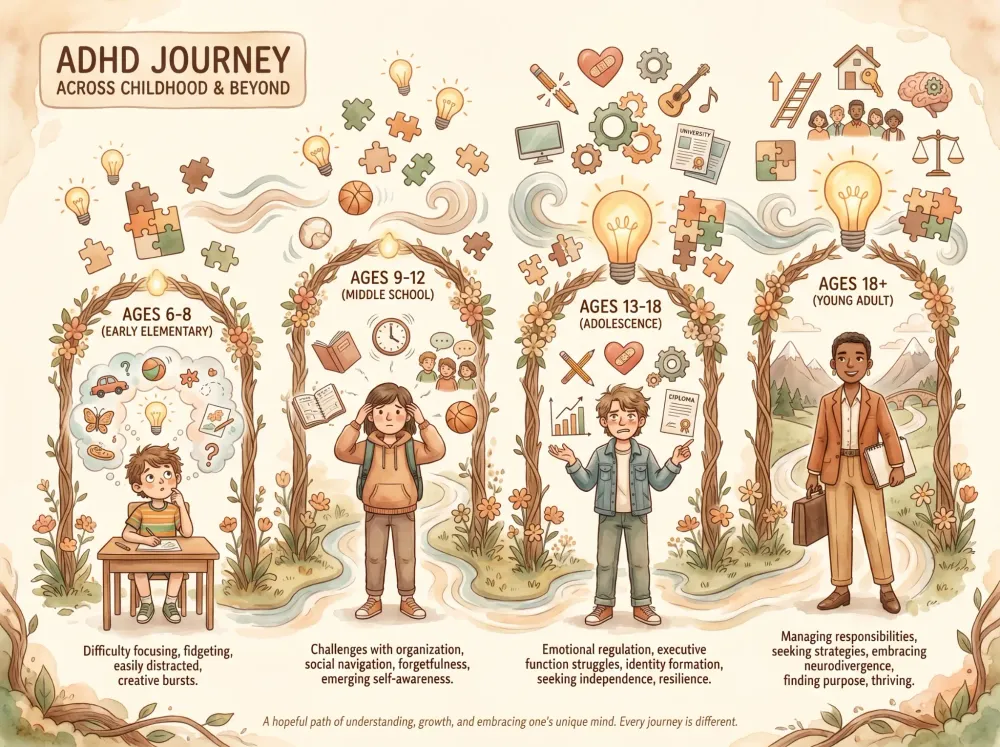
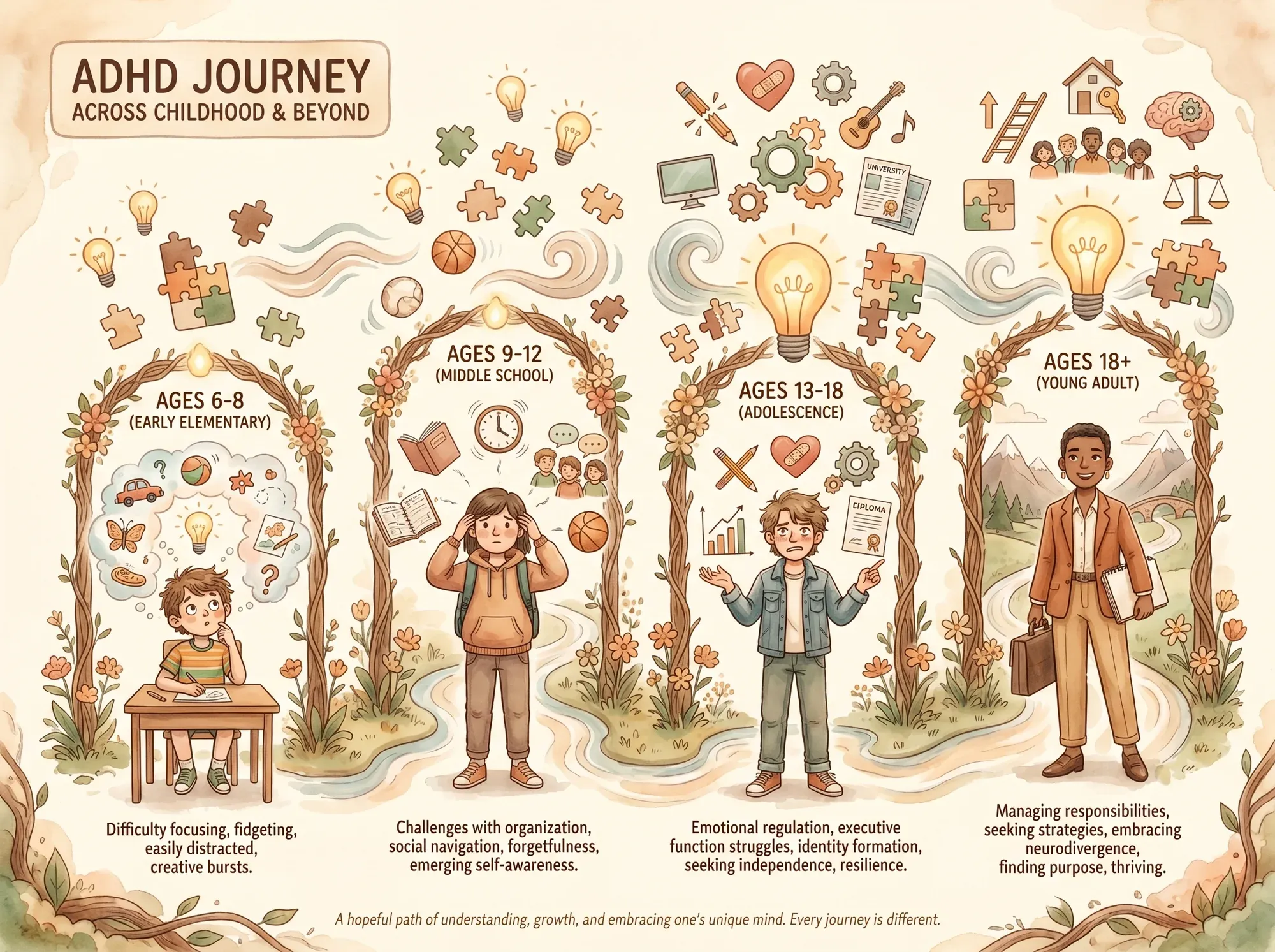
What to Expect by Age
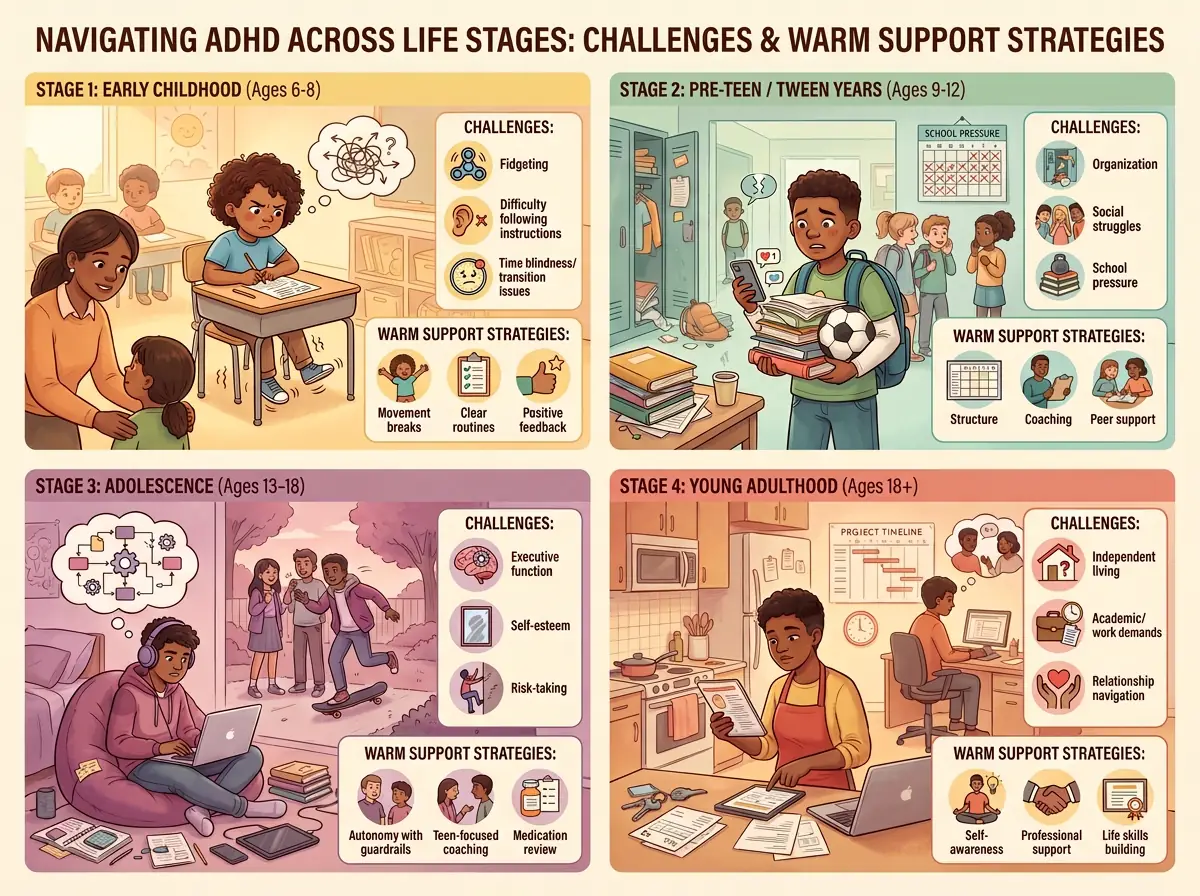
"Long-term prognosis" can feel abstract. What most parents really want to know is, "What should I expect this year, and what's around the corner?"
Download the full-size infographic
Early Childhood (Ages 6 to 8)
This stage is usually when ADHD gets identified. A child who got by on natural smarts and a lot of parental scaffolding suddenly faces a classroom of 25 kids where sitting still and following multi-step directions matter.
Prognosis at this age depends heavily on how quickly support starts. Early identification and prompt treatment create a better path from here. It also protects self-esteem at a time when kids are still forming their sense of who they are.
For preschoolers who are already showing significant signs, behavior-based parent training is the recommended starting point. You can read more in Treating ADHD in Young Children: A Practical Approach.
Elementary and Middle School (Ages 9 to 12)
This is the trajectory-setting phase. Academic patterns start to solidify. A child who got help early often carries that momentum forward. A child who's been struggling for years watches the gap with classmates widen.
Friendships matter more now, too. Kids with ADHD who are struggling academically are more likely to be targets of social rejection, which adds to the emotional load. If friendships are a sore spot, How to Help Children with ADHD Make Friends has practical ideas.
The good news? Treatment still helps tremendously at this age. Kids can catch up, with consistent support.
The Teen Years (Ages 13 to 18)
Real talk: for many families, adolescence is the hardest stretch of ADHD.
Why? Executive function demands explode. Suddenly your teen has to juggle multiple classes, long-term projects, a sleep schedule, a phone, and complicated friendships, all while the brain's "air traffic control center" (the prefrontal cortex) is still under construction. Add puberty, identity formation, and peer pressure, and you've got a perfect storm.
The teen years carry the highest risk for school failure, risky driving, substance experimentation, and mood problems. It's also when many worn-out parents step back, just when their teen needs them most.
But here's the counterintuitive part. Adolescence is also when good support makes some of its biggest gains. Organizational coaching, mentorship, school accommodations, and a parent who stays engaged (with more autonomy and more guardrails) can change the trajectory.
Young Adulthood (18 to 25)
Here's the plot twist. For many young people with ADHD, things start getting better in early adulthood.
The rigid structure of school is gone. Work can be more flexible and more interest-driven. Young adults with ADHD often discover environments that suit their brains, develop their own systems, and stop being compared with 25 other kids in a classroom.
In the MTA study, about 30% of children with ADHD experienced full remission at some point along the way (Sibley et al., 2022). Others don't fully remit but learn their brain's operating manual and build lives around their strengths. By their late 20s, many tell me they finally feel like they're catching up.
Risk Factors: What Makes Outcomes Worse
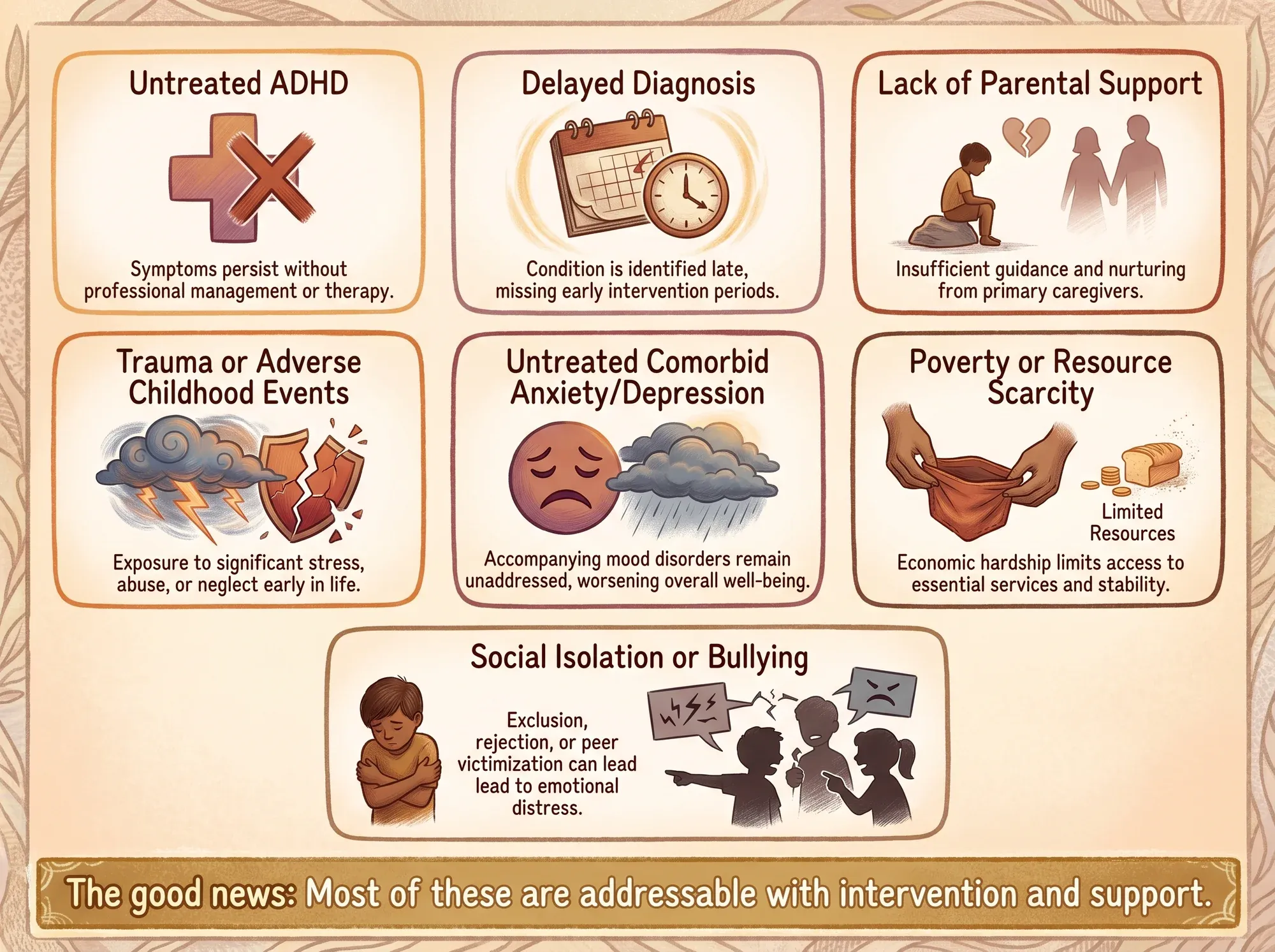
Let's be direct about what makes the road harder, because knowing the risks helps you protect against them.
Download the full-size infographic
Untreated ADHD
This is the big one. The school and job numbers we covered earlier are worse when ADHD goes unidentified and untreated. And the effects don't stay at school. They spill into friendships, family life, self-esteem, and mental health.
Untreated Anxiety or Depression
When ADHD comes with anxiety or depression, kids tend to struggle more at school and with friends, and treatment gets more complex. Watch for worry, withdrawal, irritability, hopelessness, or a child who stops trying. If your child ever talks about not wanting to be alive, call or text 988 (the Suicide & Crisis Lifeline) right away, and call 911 if anyone is in immediate danger.
Late Diagnosis
Every year a child struggles without an explanation is a year of academic and social damage and a year of building the wrong story about who they are. This is especially true for girls.
A Harsh or Blaming Home Climate
A child whose parents don't understand ADHD, or who hears every day that he or she is lazy or bad, tends to internalize shame. That shame can outlast the ADHD symptoms themselves.
Trauma and Adversity
ADHD plus trauma means more complex needs. Trauma can intensify ADHD-like symptoms and make kids more reactive and harder to regulate.
Limited Access to Care
Families with fewer resources often have less access to evaluation, therapy, medication, and coaching. That gap in access becomes a gap in outcomes.
When ADHD Comes With Other Conditions
Remember that 78% figure? Most kids with ADHD have something else going on, too. The most common pairings:
ADHD and Anxiety
ADHD brings impulsivity and trouble focusing. Anxiety brings worry, perfectionism, and avoidance. Together they can create a kid who's too anxious to start and too impulsive to stop and think. Treatment needs to address both. If you're not sure which is driving what, my article ADHD versus Anxiety in Children walks through the differences.
ADHD and Depression
Depression often develops over time. A child with untreated ADHD who experiences years of failure, rejection, and shame may become depressed by the teen years. Now you've got a kid who is both impulsive and unmotivated, which is a harder combination to treat.
ADHD and Sleep Problems
Sleep problems are very common with ADHD, and they make ADHD worse. A tired child is more impulsive, more emotional, and less able to focus. Families who tackle sleep alongside ADHD treatment often see big improvements. If bedtime is a battle at your house, see My Child Won't Sleep.
ADHD and Behavior Problems
According to the CDC, almost half of children with ADHD also have a behavior or conduct problem. Defiance, arguing, and rule-breaking can strain a family fast. Parent training and consistent structure are especially important here.
Three Paths I See Over and Over
Every child's story is different. But over three decades, I've seen a few patterns repeat. The three examples below are composites, not real patients. Names and details are invented to protect privacy.
Sophia: Identified Early
Sophia's second-grade teacher noticed she seemed to "daydream" a lot. Her parents had her evaluated, and she was diagnosed with inattentive ADHD. She started treatment, and her school put a 504 Plan in place.
By high school, Sophia had earned mostly B's and C's. Not straight A's, but solid. In college, she found a setting that worked for her brain, and she graduated. Today she works in marketing, where her quick, creative thinking is an asset.
Marcus: Identified Late, Still Okay
Marcus wasn't diagnosed until high school. For years he'd been labeled a "troublemaker." He struggled through school, then found his footing in a hands-on trade where his energy was an advantage. Today he runs his own business. He wishes he'd been diagnosed earlier (it could have spared him years of shame), but he got there.
Devon: Diagnosed but Untreated
Devon was diagnosed at 8, but his family chose not to pursue treatment or school supports. He coasted through elementary school on raw intelligence. High school hit different. He fell behind, dropped out, and struggled with jobs and substance use in his 20s. He's doing better now after getting treatment as an adult, but untreated ADHD cost him years.
Bottom line: ADHD itself doesn't decide a child's destiny. How we respond to it makes the biggest difference.
What You Can Do Starting Today
You've read the research. You know the risks and the protective factors. Here's what to actually do.
- Get an evaluation if you're wondering. Don't wait for the school or the pediatrician to bring it up. Earlier identification means earlier help and better long-term outcomes. If you're not sure whether what you're seeing is ADHD, start with Is It ADHD or Just Kids Being Kids?
- Build a multimodal plan. Combine the tools that fit your child (parent training, therapy, school supports, and medication when appropriate) instead of choosing just one and hoping it's enough.
- Get school supports in writing. Ask about an IEP or 504 Plan, and follow up with teachers regularly.
- Watch for anxiety, depression, and sleep problems. Get them treated early if they show up.
- Create predictable structure. Routines reduce friction and give an ADHD brain the scaffolding it doesn't build on its own.
- Protect self-esteem. Catch your child doing well. Talk about ADHD as a difference to manage, not a flaw.
- Find your child's place to shine. A sport, an instrument, a club, or a hobby where ADHD isn't the main story.
- Plan ahead for transitions. New schools, puberty, driving, and graduation are high-risk moments. Add support before them, not after.
- Build your own support team. Parent coaching, a support group, and family members who get it. You can't pour from an empty cup.
- Stay in the game through the teen years. Your teen may push you away. Stay close anyway, with more autonomy and clear guardrails.
Here's a printable checklist to keep handy. Download it, print it, and put it somewhere you'll see it every day.
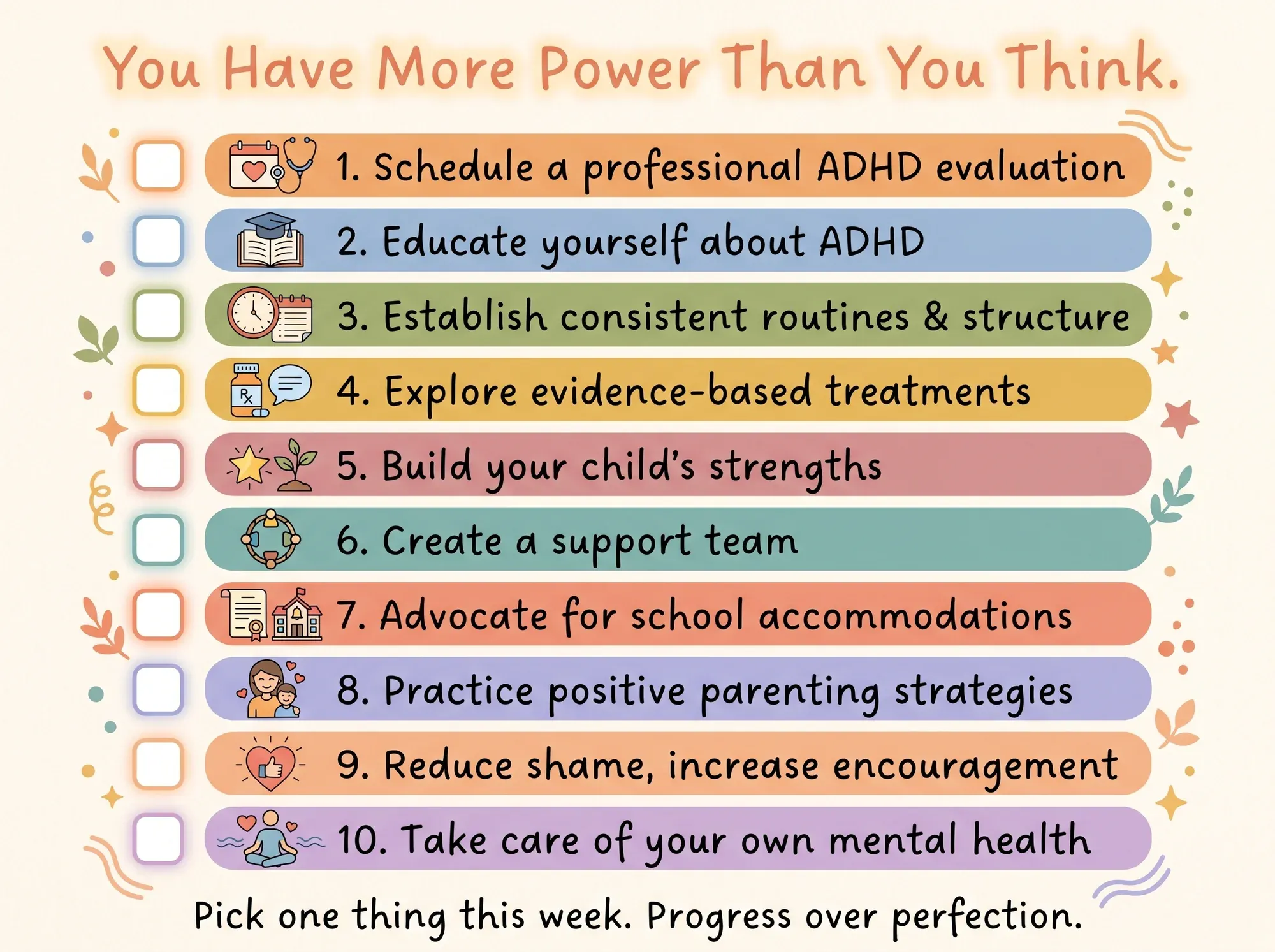
Download the full-size infographic
Ready to Learn More About ADHD at Help For Your Child?
If you're wondering whether your child has ADHD, or you're looking for a team to help with a diagnosis you already have, start with our ADHD page. You'll find the warning signs we look for, how our diagnostic evaluation works, and how our psychologist and psychiatrist work together under one roof on treatment.
The Bottom Line: Hope and Realism
Here's what the research tells us: your child's future with ADHD is not predetermined.
Most children with ADHD grow into adults who work, love, and build good lives. Some thrive in ways that kids without ADHD never get the chance to. But that doesn't happen by accident. It happens through early identification, consistent treatment, school advocacy, and a home where a child feels understood.
Your child doesn't need to be fixed. Your child needs to be understood, supported, and believed in, and you're already doing that by reading this article.
If you're feeling stuck or overwhelmed, or you just want a professional opinion, you don't have to figure this out alone. Take a deep breath, and take the next step.
Your kiddo's future isn't written yet. You're helping write it.
God bless you and your family.
— Dr. John Carosso, Psy.D.

Contact Help For Your Child
John Carosso, Psy.D and Robert Lowenstein, MD, a psychologist and a psychiatrist, work together in the same practice to evaluate and treat ADHD in children and teens ages 2 to 17. Learn more about how we can help on our ADHD page, or reach out directly:
- Phone: (724) 850-7200
- Email: hello@helpforyourchild.com
- Website: helpforyourchild.com
Frequently Asked Questions
Will my child with ADHD be okay?
For most children, yes. Long-term studies show that most kids with ADHD grow into adults who work, build relationships, and live full lives, and about two-thirds show no diagnosable mental disorder by their mid-20s. Outcomes are best when ADHD is identified early, treated consistently, and supported at home and school. Your involvement is one of the strongest predictors of how things turn out.
Do kids with ADHD grow up to be successful?
Many do, including doctors, teachers, entrepreneurs, tradespeople, and artists. On average, kids with ADHD face more obstacles in school and early careers, but averages aren't destiny. Kids who get treatment, school supports, and encouragement to build on their strengths often find work that fits how their brains are wired.
Does ADHD go away with age?
Usually not completely. Hyperactivity often eases in the teen years, while inattention and executive function challenges tend to linger. In the MTA study, only about 9% of children achieved lasting full remission, but most had fluctuating symptoms, with good stretches and harder ones. Many adults learn to manage ADHD so well that it no longer gets in the way.
Can untreated ADHD get worse with age?
ADHD itself doesn't typically worsen, but its consequences can pile up. Years of academic struggle, peer rejection, and criticism can lead to anxiety, depression, and risky behavior by the teen years. Treatment is linked to better outcomes, including fewer suicide attempts, less substance misuse, and fewer accidents.
When does ADHD peak in boys?
Diagnosis most often happens in early elementary school. In a large Danish study, new ADHD diagnoses in boys peaked at age 8. The challenges themselves often peak in the teen years, when school and life demand much more planning and self-control.
How is ADHD different in teenage girls?
Teenage girls with ADHD are more likely to have the inattentive type, which is quieter and easier to miss. Many aren't diagnosed until their teens or later, after years of struggling privately. They're also at higher risk for anxiety and depression, so a thorough evaluation should look at mood as well as attention.
Can ADHD be treated without medication?
Yes, for some children. For preschoolers, the American Academy of Pediatrics recommends parent training in behavior management as the first step. For older children, the best results usually come from combining approaches, such as behavior therapy, school supports, and medication when appropriate. Talk with your child's doctor about what fits, and never start, stop, or change medication without professional guidance.
Is ADHD considered a disability?
For school purposes, it can be. ADHD can qualify a child for a 504 Plan under Section 504 of the Rehabilitation Act or for special education services through an IEP when it significantly affects learning. How your family talks about ADHD is a separate matter. Many families describe it as a difference that needs support, which helps protect a child's self-esteem.
How do I know if my child's ADHD is mild, moderate, or severe?
Severity is about how much ADHD gets in the way of daily life (school, home, friendships, and self-esteem), not how hyperactive a child looks. A thorough diagnostic evaluation looks at all of those areas. Severity can also change with treatment: a child with moderate ADHD who gets consistent support may function more like a child with mild ADHD.
What if my child with ADHD is also gifted?
Intelligence can hide ADHD for years. Gifted kids often coast through elementary school, then hit a wall in middle school, high school, or college when the workload outgrows their ability to compensate. If your bright child is disorganized, procrastinates constantly, or is underperforming, an evaluation now can prevent a crisis later.
Sources
- ADHD Prevalence Among U.S. Children and Adolescents in 2022: Diagnosis, Severity, Co-Occurring Disorders, and Treatment, Danielson et al., Journal of Clinical Child and Adolescent Psychology, summarized by the Centers for Disease Control and Prevention, 2024
- QuickStats: Percentage of Children and Adolescents Aged 5–17 Years Who Had Ever Received a Diagnosis of ADHD, by Sex and Year — United States, 2019–2025, Centers for Disease Control and Prevention, Morbidity and Mortality Weekly Report, 2026
- Clinical Practice Guideline for the Diagnosis, Evaluation, and Treatment of ADHD in Children and Adolescents, American Academy of Pediatrics, 2019
- ADHD and Long-Term Outcomes (summaries of Barbaresi et al., 2013; Biederman et al., 2010; Breslau et al., 2011; Owens et al., 2015; and Kuriyan et al., 2013), CHADD
- Long-Term Prognosis in Attention-Deficit/Hyperactivity Disorder, Mannuzza and Klein, Child and Adolescent Psychiatric Clinics of North America, 2000
- Variable Patterns of Remission From ADHD in the Multimodal Treatment Study of ADHD, Sibley et al., American Journal of Psychiatry, 2022 (University of Washington news release)
- Characteristics and Predictors of Fluctuating ADHD in the Multimodal Treatment of ADHD (MTA) Study, Sibley et al., Journal of Clinical Psychiatry, 2024 (UW Medicine news release)
- New Research Shows ADHD Symptoms Can Go Up and Down: What Does This Mean?, Margaret Sibley, Attention magazine (CHADD), 2021
- Attention-Deficit/Hyperactivity Disorder Traits in Childhood and Physical Health in Midlife, John et al., JAMA Network Open, 2026 (University College London news release via ScienceDaily)
- Young Adult Outcome of Hyperactive Children: Adaptive Functioning in Major Life Activities, Barkley et al., Journal of the American Academy of Child and Adolescent Psychiatry, 2006
- Young Adult Educational and Vocational Outcomes of Children Diagnosed with ADHD, Kuriyan et al., Journal of Abnormal Child Psychology, 2013
- ADHD Drug Treatment and Risk of Suicidal Behaviours, Substance Misuse, Accidental Injuries, Transport Accidents, and Criminality, Zhang et al., The BMJ, 2025 (BMJ Group news release)
- The Effect of Treatment Duration on the Prognosis of ADHD: A Multi-Center Naturalistic Follow-Up Study, Ercan et al., Psychiatry Research, 2025
- Incidence Rates and Cumulative Incidences of the Full Spectrum of Diagnosed Mental Disorders in Childhood and Adolescence, Dalsgaard et al., JAMA Psychiatry, 2020

Get Dr. Carosso’s latest articles by email
Trusted, practical guidance for your family, delivered straight to your inbox as soon as Dr. Carosso publishes new content.