by Dr. John Carosso, Psy. D.

Here's a scene I see in my office all the time: a parent sits down, takes a breath, and says, "My child can't focus, they're restless, they melt down over homework, so it must be ADHD, right?"
Maybe. But here's the thing. Anxiety can look exactly the same way.
A child who can't sit still might be hyperactive. Or they might be so consumed by worry that their body can't settle down. A child who "zones out" in class might have an attention deficit. Or their mind might be racing with fears about saying the wrong thing. Same behaviors on the outside, but very different things are happening on the inside.
As a child psychologist with over 30 years of experience evaluating kids right here in the Pittsburgh area, the question of ADHD versus anxiety is something that comes up all the time. These two conditions are among the most commonly confused in children. Missing the distinctions between the two not only delays the right treatment but can also make the situation worse.
So let's untangle this issue together. I'll explain how ADHD and anxiety overlap, how they're different, and how to get your child the help they need.
Article at a Glance
- ADHD and anxiety share many of the same visible behaviors in children, including trouble focusing, restlessness, emotional outbursts, and task avoidance.
- The core difference is what’s driving the behavior: ADHD is a brain-wiring issue, while anxiety is a worry issue.
- ADHD symptoms stay consistent across all settings. Anxiety symptoms tend to fluctuate based on stress and situation.
- Up to 50% of children with ADHD also have an anxiety disorder, making accurate diagnosis especially important.
- Untreated ADHD often causes anxiety over time as children accumulate negative experiences at school and with peers.
- Girls with inattentive ADHD are frequently misdiagnosed with anxiety because their symptoms are quiet rather than disruptive.
- Treating ADHD first often reduces anxiety when both conditions are present, but they should both be monitored.
- A comprehensive evaluation, not a quick checklist, is the only reliable way to tell the difference and build the right treatment plan.
How ADHD and Anxiety Look So Similar in Kids
Before we discuss the differences, let's be honest about why the situation is so confusing. ADHD and anxiety share a surprising number of overlapping symptoms, and they can fool even experienced teachers and clinicians.
Both conditions can show up as:
- Trouble focusing. Whether it's ADHD-driven distractibility or anxiety-driven mental preoccupation, the result looks the same: a child who can't seem to pay attention.
- Restlessness and fidgeting. Kids with ADHD fidget because their brains crave stimulation. Kids with anxiety fidget because their bodies are wound up with nervous energy. From across the classroom? Same behavior.
- Emotional outbursts. Meltdowns, irritability, crying over "nothing." Both conditions can lead a child to exceed their emotional limits.
- Sleep problems. ADHD makes it difficult to wind down. Anxiety fills bedtime with racing thoughts and fears. Either way, your child isn't sleeping well.
- Avoiding tasks. A child with ADHD avoids boring, effortful work. A child with anxiety avoids anything that feels threatening or overwhelming. Both kids end up not doing the homework.
See the problem? When you're looking at behavior alone, especially in a busy classroom or a hectic household, these two conditions can be nearly impossible to tell apart.
And to make things even more complicated? A child can have both. In fact, research shows that up to 50% of children with ADHD also meet the criteria for an anxiety disorder. So it's not always one or the other. Sometimes it's both at once.
How to Tell If It's ADHD or Anxiety
If the surface-level behaviors appear similar, how can we determine what is truly happening? The key is to look underneath the behavior, at what's driving it.
Here's the simplest way I explain it to parents: ADHD is a brain-wiring issue. Anxiety is a worry issue. Both affect focus and behavior, but for entirely different reasons.
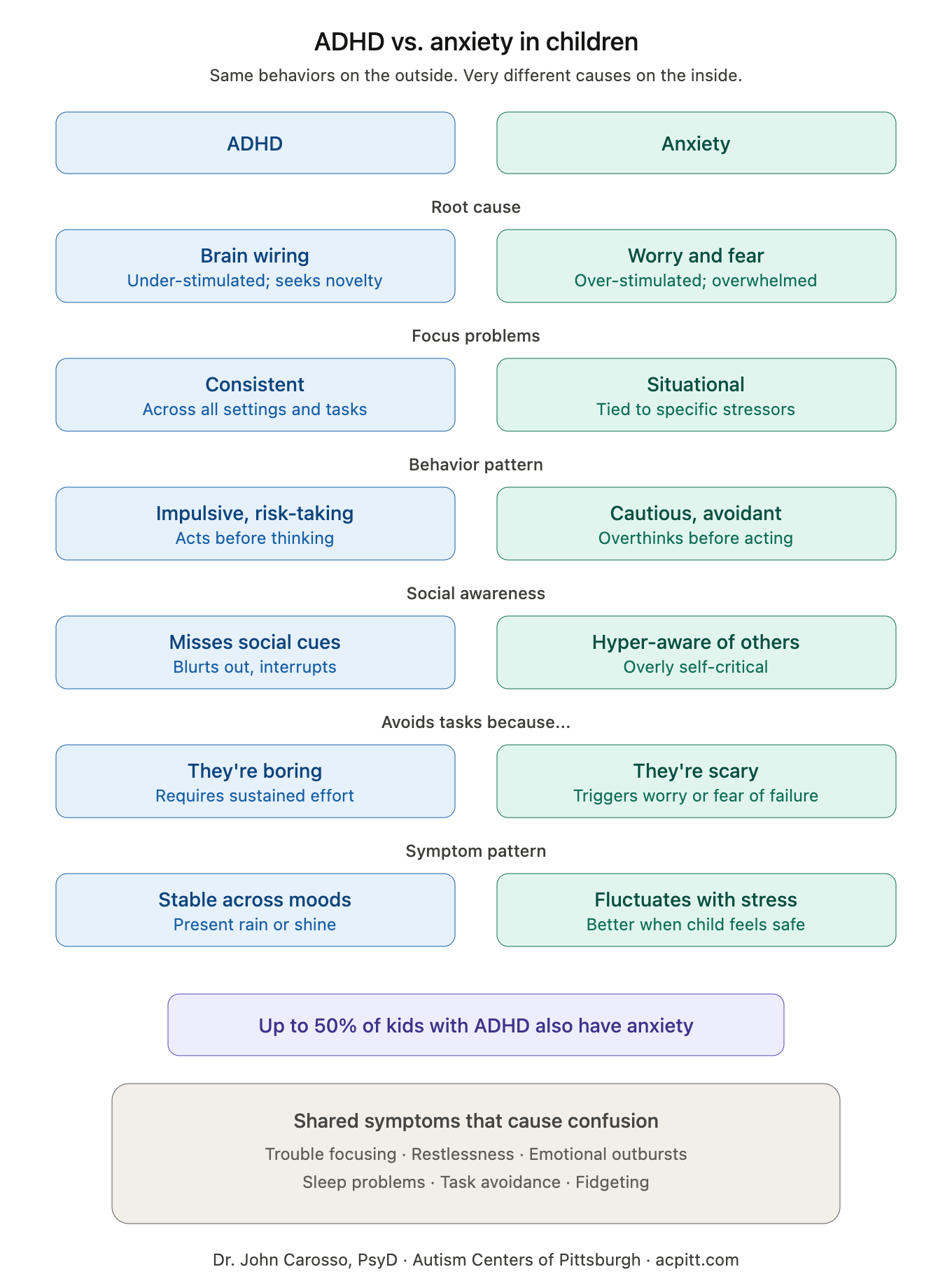
Let me break that down with a side-by-side comparison:
ADHD | Anxiety |
Brain is understimulated; it seeks novelty and excitement. | Brain is overstimulated, overwhelmed by fear or worry. |
Difficulty focusing happens across all settings: home, school, activities | Difficulty focusing is often tied to specific stressors or situations. |
Impulsivity and risk-taking are common. | Cautious, avoidant behavior is more typical. |
May miss social cues or blurt things out without thinking | May be hyper-aware of others' reactions and overly self-critical |
Symptoms are consistent and don't come and go based on mood. | Symptoms can fluctuate, worsening during stress and improving when the child feels safe. |
Avoids tasks because they're boring or require sustained effort | Avoids tasks because they trigger worry or fear of failure |
Here's a quick example to bring this scenario to life. Imagine two kids sitting in the same math class; both are distracted and neither is doing their work.
Child A (ADHD): His brain has wandered off because the worksheet is repetitive and unstimulating. He's thinking about recess, his dog, and a YouTube video—all within about ten seconds. He's not focused on his schoolwork. He's checked out and has left it behind mentally.
Child B (Anxiety): Her brain is locked on her schoolwork—specifically on the fear she might get a bad grade, that the teacher will call on her, or that other kids will think she's stupid. She's not distracted by random thoughts. She is consumed by a specific worry.
Same behavior. Entirely different internal experience. And the treatment for each child looks completely unique, too.
Could ADHD Be Mistaken for Anxiety?
Absolutely, and it happens more often than you'd think.
Here's how the situation typically plays out. A child struggles in school. They seem worried, overwhelmed, and maybe even perfectionistic. A well-meaning provider diagnoses anxiety and starts treatment, perhaps therapy, perhaps medication. But the core problems don't go away, because the real issue was ADHD all along.
What happened? The child's anxiety was real, but it was secondary. It developed as a response to living with undiagnosed ADHD. When you spend years struggling to keep up, forgetting assignments, getting reprimanded by teachers, and watching your peers do things that feel impossible for you, of course you're going to feel anxious. That anxiety is understandable, but it's a symptom of the ADHD, not the root cause.
This is especially common in girls. Girls with ADHD are more likely to have the inattentive type, meaning no hyperactivity, no impulsivity, and just quiet difficulty with focus and organization. Because they're not bouncing off the walls, they often get labeled as "anxious" or "spacey" rather than recognized as having ADHD. And that misdiagnosis can follow them for years.
Bottom line: if your child has been treated for anxiety but the treatment doesn't seem to be working, or if the anxiety keeps coming back, it's worth asking whether ADHD might be the missing piece of the puzzle.
Can Untreated ADHD Cause Anxiety?
Yes, and this is one of the most important things for parents to understand.
ADHD is a neurodevelopmental condition. It affects how the brain manages attention, impulses, and executive functioning. It's not caused by bad parenting, laziness, or a lack of willpower. It's brain wiring.
Consider the daily life of a child whose brain functions in this manner, particularly if their ADHD has not yet been identified. Every day brings new challenges: forgetting assignments, losing things, struggling to follow multi-step directions, and getting in trouble for blurting things out. Over time, these repeated struggles create an ideal environment for anxiety to develop.
Here's the chain I see play out in my practice, over and over:
- The child struggles with schoolwork, organization, social interactions, or self-control.
- Negative feedback piles up from teachers, parents, coaches, and peers.
- Self-doubt sets in. "Why can't I do what everyone else can do?"
- Anxiety emerges. The child starts to worry constantly about making mistakes, getting in trouble, or falling behind.
In other words, the anxiety isn't the problem. It's a downstream consequence of the ADHD. And here's the kicker: if you only treat the anxiety without addressing the underlying ADHD, the anxiety will keep coming back because the root cause hasn't changed.
On the flip side, when you do treat the ADHD effectively, many children experience a significant reduction in their anxiety because the daily struggles that were feeding the worry are finally being addressed.
Can a Child Have Both ADHD and Anxiety?
Yes, and it's more common than most parents realize.
Research consistently shows that about one in four children with ADHD also has a diagnosable anxiety disorder, and some studies put that number even higher, closer to one in two. That includes generalized anxiety, social anxiety, separation anxiety, and specific phobias.
When both conditions are present, they tend to feed off each other. The ADHD creates situations that trigger anxiety (missed assignments, social mistakes, poor grades), and the anxiety makes the ADHD symptoms harder to manage because a worried brain has even less bandwidth for focus and organization.
This is why a thorough evaluation is so critical. If a clinician only screens for one condition, they may miss the other entirely, and a treatment plan that addresses only half the picture won't produce the results your child needs.
What ADHD vs. Anxiety Looks Like at Different Ages
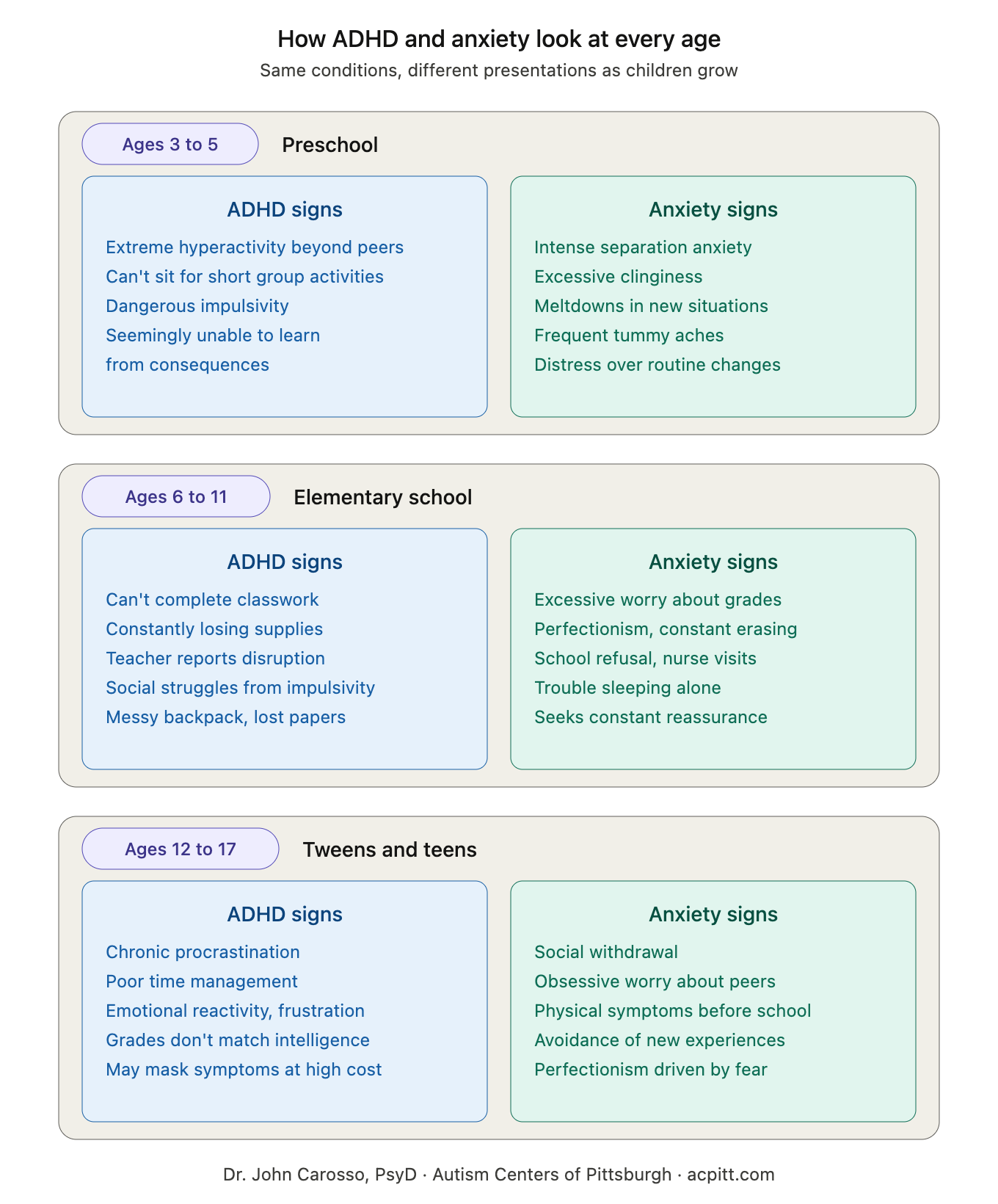
Most articles on this topic seem to miss one important thing: how differently these conditions show up depending on your child's age. A preschooler with ADHD doesn't look like a teenager with ADHD, and the same goes for anxiety. So let's walk through what to watch for at each stage.
| Age Group | ADHD Signs | Anxiety Signs |
| Preschool (3–5) | Extreme hyperactivity beyond peers, can't sit for short group activities, dangerous impulsivity, seemingly unable to learn from consequences | Intense separation anxiety, excessive clinginess, meltdowns in new situations, frequent tummy aches, distress over routine changes |
| Elementary (6–11) | Can't complete classwork, constantly losing supplies, teacher reports disruption, social struggles from impulsivity, messy backpack and lost papers | Excessive worry about grades, perfectionism and constant erasing, school refusal and nurse visits, trouble sleeping alone, seeks constant reassurance |
| Tweens/Teens (12–17) | Chronic procrastination, poor time management, emotional reactivity and frustration, grades don't match intelligence, may mask symptoms at high cost | Social withdrawal, obsessive worry about peers, physical symptoms before school, avoidance of new experiences, perfectionism driven by fear |
Preschool (Ages 3–5)
At this age, all kids are impulsive, active, and emotionally reactive. That's developmentally normal. So it takes a trained eye to distinguish between typical preschool behavior and something more.
ADHD signs at this age tend to show up as extreme hyperactivity (well beyond what peers are doing), an inability to sit for even short group activities, and a pattern of dangerous impulsivity: running into traffic, climbing things they shouldn't, and seemingly being unable to learn from consequences.
Anxiety signs at this age often present as intense separation anxiety that doesn't ease with time, excessive clinginess, meltdowns in new situations, frequent physical complaints (tummy aches, headaches), and extreme distress over minor changes in routine.
Elementary School (Ages 6–11)
This is the age when both conditions become much more visible, because school demands expose the gaps.
ADHD signs at this age include chronic difficulty completing classwork and homework, constant teacher feedback about not paying attention or disrupting others, lost papers and supplies, messy backpacks, and social struggles related to impulsivity (interrupting, not waiting turns, being "too much").
Anxiety signs at this age include excessive worry about grades or performance, perfectionism (erasing and rewriting until the paper tears), school refusal or frequent trips to the nurse, difficulty sleeping alone, and a tendency to seek constant reassurance. "Did I do it right? Are you sure?"
Tweens and Teens (Ages 12–17)
By adolescence, both conditions can become more internalized and harder to spot.
ADHD in teens often looks like chronic procrastination, difficulty with long-term projects, poor time management, emotional reactivity (especially frustration), and academic performance that doesn't match the teen's obvious intelligence. Some teens develop compensatory strategies that mask their ADHD, but at a high internal cost.
Anxiety in teens can present as social withdrawal, obsessive worry about peer perception, physical symptoms (chest tightness, nausea before school), avoidance of new experiences, and, in some cases, panic attacks. Anxious teens may also become perfectionistic overachievers, driven not by ambition but by terror of failure.
At every age, the through line is the same: look beneath the behavior to understand what's driving it.
How ADHD and Anxiety Are Diagnosed
If you're reading this article and thinking, "This sounds like my child," then the next step is a comprehensive evaluation. Could you please describe what that process entails? I'll guide you through it, as I think knowing what to expect eases some of the stress.
What a Good Evaluation Includes
A solid evaluation isn't a ten-minute checklist at a pediatrician's office. It typically involves:
- A detailed clinical interview with both you (the parent) and your child. I want to hear about your child's history, daily struggles, what triggers the behaviors, and how things look across different settings.
- Standardized rating scales. Tools like the Vanderbilt Assessment Scale (for ADHD) and the SCARED questionnaire (for anxiety) help measure symptom severity. These are often completed by parents and teachers to get a fuller picture.
- Behavioral observations. How does your child behave during the evaluation itself? Do they seem restless? Worried? Distracted?
- Developmental and medical history to rule out other possible causes and identify any co-occurring conditions.
- Input from multiple sources. Teachers, school counselors, and other caregivers can provide perspectives that parents might not see at home.
What Parents Can Do to Prepare
Before the evaluation, spend a week or two observing your child's behavior more closely. Ask yourself: When do the problems happen? Are they consistent across all settings, or do they show up mainly at school, at home, or in social situations? Keeping a brief daily log, even just a few notes on your phone, gives the evaluating clinician incredibly useful information.
Furthermore, don't hesitate to ask your child's teacher for their observations. Teachers see your child in a structured environment for hours every day, and their input is invaluable.
Will ADHD Meds Help with Anxiety?
This is one of the most common questions I hear from parents, and the answer is: it depends on where the anxiety is coming from.
If your child's anxiety is secondary to ADHD, meaning it developed as a result of the daily struggles caused by untreated ADHD, then yes, treating the ADHD with stimulant medication often leads to a meaningful reduction in anxiety as well. Once the core attention and executive function challenges improve, the situations that were generating all that worry start to resolve, and the anxiety naturally decreases.
However, there are two important caveats.
First, stimulant medications can sometimes increase anxiety in children who have a true, independent anxiety disorder alongside ADHD. This doesn't mean that stimulants are completely ruled out, but it does require the clinician to closely monitor and adjust the treatment plan as necessary.
Second, if the anxiety is primary, meaning it exists on its own and not because of ADHD, then ADHD medication alone isn't likely to resolve it. In these cases, your child may benefit from Cognitive Behavioral Therapy (CBT), which is the gold-standard treatment for childhood anxiety disorders, or from an SSRI medication (like sertraline), or from a combination of both.
The research is clear on this point: when ADHD and anxiety co-occur, the best outcomes come from treating both conditions, not just one. Your child's clinician should be monitoring both sets of symptoms over time and adjusting the plan accordingly.
Practical Strategies for Parents
While you're working toward a diagnosis and treatment plan, there are things you can start doing at home right now that can help a child with either ADHD or anxiety, or both.
For Focus and Organization (Especially Helpful for ADHD)
Try the 20-minute rule. Instead of asking your child to sit and do homework for an hour straight (which feels impossible for a child with ADHD), break it into 20-minute chunks with short breaks in between. Work 20 minutes, take a 5-minute movement break, then come back. You'll be amazed at how much more gets done.
Use visual cues and checklists. Kids with ADHD respond well to visual structure: color-coded folders, posted daily routines, and checklists on the fridge. Make the expectation visible so your child doesn't have to hold it all in their working memory.
Give one instruction at a time. Multi-step directions can be particularly challenging for children with ADHD. Instead of "Go upstairs, brush your teeth, put on pajamas, and pick out a book," try one step at a time with a check-in in between.
For Worry and Overwhelm (Especially Helpful for Anxiety)
Teach the 3-3-3 rule. When your child feels anxious, have them name three things they can see, three things they can hear, and three things they can physically touch or feel. This simple grounding technique pulls the brain out of the worry spiral and back into the present moment. It's quick, it's portable, and kids can do it anywhere, even in the middle of class.
Validate first, problem-solve second. When your child is anxious, their brain is in threat mode. Jumping straight to "There's nothing to worry about" actually makes things worse. Instead, try, "I can see you're really worried about your feelings. That makes sense. Let's figure it out together."
Practice gradual exposure. Avoiding the scary thing feels good in the short term but makes anxiety worse over time. With your child's therapist, work on gradually approaching feared situations in small, manageable steps, building confidence along the way.
For Both ADHD and Anxiety
Keep routines predictable. Both ADHD and anxious brains benefit enormously from knowing what comes next. Consistent morning, after-school, and bedtime routines reduce the number of daily decisions and transitions your child has to manage.
Prioritize sleep, exercise, and nutrition. I know, this sounds basic. But a sleep-deprived child who is sedentary and living on processed food will struggle more with any mental health condition. These aren't cures, but they create a foundation that makes everything else work better.
Focus on effort, not outcomes. Whether your child is battling attention problems or worry, they need to hear that you see how diligently they're trying. "I noticed you really stuck with that homework even when it was tough" goes further than "You got an A."
When to Seek Help
If your child's difficulties with focus, worry, behavior, or emotions are consistently interfering with their ability to function at home, at school, or with friends, it's time to get a professional evaluation. Trust your gut on this. You know your child better than anyone.
And here's something I want to be really direct about: don't wait. The longer ADHD or anxiety goes unidentified, the more your child accumulates negative experiences (academic struggles, social rejection, self-doubt) that become harder to undo later. Early identification leads to early intervention, and early intervention leads to better outcomes. Period.
Take the first step
Whether you’re in the Pittsburgh area, you live elsewhere in Pennsylvania, or you're even out of state, don’t navigate your situation alone. Move from uncertainty to understanding—take the first step toward the answers and support you deserve.
As the Clinical Director and psychologist for Autism Centers of Pittsburgh, I provide comprehensive evaluations for ADHD, anxiety, autism spectrum disorder, and other co-occurring conditions with minimal wait time, ensuring you receive the necessary guidance, clarity, and documentation needed to proceed with confidence.
Feel free to reach out to me directly at: DrCarosso@aol.com. You can also visit Autism Centers of Pittsburgh at www.acpitt.com or call us at (724) 733-5757 to get started.
For more on these topics, check out my How We Treat series on depression, anxiety, ADHD, and emotional outbursts.
God bless you and your family.
Dr. Carosso
Article FAQ
The key difference is what's driving the behavior. A child with ADHD struggles to focus regardless of the situation because of brain-based difficulty with attention regulation. A child with anxiety may lose focus because their mind is consumed by a specific worry or fear. ADHD symptoms tend to be consistent across all settings, while anxiety-related attention problems often fluctuate based on stress levels. A comprehensive evaluation by a qualified psychologist or pediatrician is the best way to determine which condition is present or whether your child has both.
Yes. Children with untreated ADHD often experience repeated struggles with schoolwork, social interactions, and behavior expectations. Over time, this pattern of difficulty and negative feedback can lead to chronic worry, self-doubt, and anxiety. Effective treatment of ADHD often leads to a significant reduction in anxiety, as it finally addresses the daily struggles that were fueling the worry.
Yes, and this misdiagnosis happens frequently, especially in girls. Children with the inattentive type of ADHD (no hyperactivity) may appear worried, overwhelmed, or spacey, which can be mistaken for an anxiety disorder. If your child has been treated for anxiety but the treatment isn't producing lasting improvement, it is worth asking whether undiagnosed ADHD could be the underlying issue.
Yes. Research shows that approximately 25 to 50 percent of children with ADHD also meet the criteria for an anxiety disorder. When both conditions are present, they tend to amplify each other. The most effective treatment plans address both ADHD and anxiety together, rather than focusing on only one condition.
It depends on the source of the anxiety. If your child's anxiety developed as a result of untreated ADHD struggles, then treating the ADHD with stimulant medication often reduces the anxiety as well. However, if the anxiety is an independent condition, ADHD medication alone may not resolve it, and in some cases stimulants can temporarily increase anxiety symptoms. A clinician should monitor both conditions and adjust the treatment plan as needed.